Custom vs. Semi-Custom vs. Stock Cabinets: An Honest Breakdown
The three tiers of cabinetry are real categories with real differences in materials, construction, design freedom, and lead time. Here is what each one actually is, and how to tell which one fits your project.
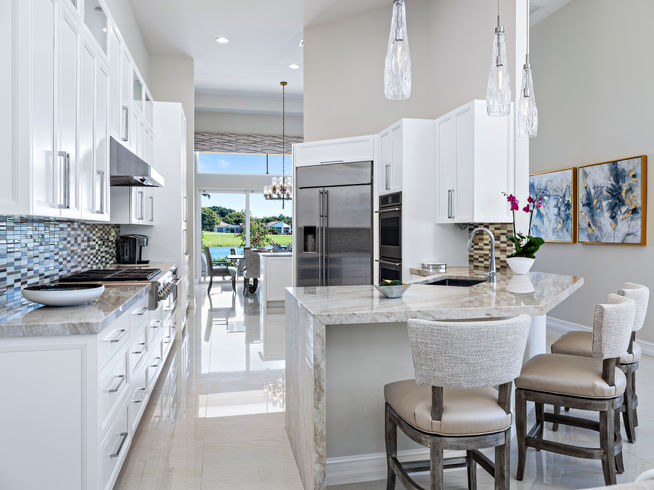
The three tiers of cabinetry are real categories. Stock, semi-custom, and custom are not marketing labels. They describe meaningfully different products with meaningfully different design freedom, materials, and lead times. Understanding the difference is the first step to matching the cabinetry to the project.
This piece walks through each tier honestly. It is not an argument for the custom tier. It is an argument for matching the cabinetry to the project. We build at the custom end of the market, but we also know which projects do not need that level of work, and we will say so.
Stock cabinetry
Stock cabinetry is mass-produced in a few standard sizes, sold from inventory, and assembled either at the factory or on site by the dealer or homeowner. The cabinet boxes are typically melamine-faced particleboard or thermofoil-wrapped MDF. Doors are the visible element and are usually offered in a small set of finish and style combinations. Hardware is basic: wire-pull soft-close hinges and slides if you are lucky, friction hinges if you are not.
Lead time: Days to a few weeks. You order from inventory. If the SKU is in stock, it ships when you pay.
Where stock works well: Rental properties, secondary residences, basement kitchens, garage workshops, laundry rooms, and any space where the cabinetry is functional and not architectural. Stock cabinetry that is well-installed in an appropriate setting looks fine and lasts a reasonable amount of time.
Where stock does not work: Primary residences where the homeowner expects the cabinetry to be a defining element of the room. South Florida humidity is also rough on the particleboard substrates that most stock cabinetry uses. A stock kitchen in a Jupiter primary residence will start showing edge swelling and door drop within five years, sometimes sooner.
Semi-custom cabinetry
Semi-custom is the middle tier and the largest segment of the market by volume. The product is built to order from a catalog of standard sizes with optional modifications. You can change the door style, the finish color, the hardware, and a few key dimensions, but the cabinet box construction, the joinery, and the materials are largely fixed by the manufacturer.
The substrate is typically furniture-grade plywood or hardwood-grade ply, depending on the brand. Doors are solid wood or veneer-wrapped engineered wood. Joinery on the boxes is usually dado-and-dowel or biscuit, sometimes with metal corner brackets for reinforcement. Hardware is from major suppliers (Blum, Salice, Hettich) depending on the brand.
Lead time: Six to twelve weeks from order to delivery. Installation adds another two to four weeks depending on scope.
Where semi-custom works well: Most American homes. Most renovations. Most situations where the homeowner wants a quality product, has some flexibility on layout to fit the catalog options, and is not specifying anything unusual in materials or proportions. Semi-custom is the right answer for the majority of kitchens in the country.
Where semi-custom does not work: Spaces with awkward dimensions that do not fit catalog sizes. Designs that require custom proportions, custom door profiles, or custom finishes. Architectural millwork that needs to integrate with paneling, coffered ceilings, or stonework. Homes where the cabinetry is part of the architecture rather than an addition to it.
Custom cabinetry
Custom cabinetry is fabricated from a clean drawing for the specific room. There is no catalog. The cabinet boxes are sized to the wall they are going on, the doors are designed for the proportions the room requires, the materials are selected for the project, and the finish is built up in coats appropriate to the use and the climate. Joinery is traditional where it matters. Hardware is selected per project rather than from a manufacturer’s standard line.
The substrate is solid wood for face frames and door panels, hardwood-grade ply or solid wood for the cabinet boxes, and marine-grade ply for high-humidity environments. Joinery is mortise-and-tenon, dovetail, dado-and-dowel, with biscuit reinforcement where appropriate. Drawer boxes are dovetailed solid wood. Finishes are conversion varnish or catalyzed lacquer built up in coats, or hand-rubbed oil for furniture-grade pieces.
The shop that builds custom cabinetry is also the shop that designs and installs it. The same crew handles the work from drawings through punch-list. Coordination with the project’s trades runs through the cabinetmaker.
Lead time: Twelve to sixteen weeks for a kitchen from approved drawings. Eight to twelve weeks for a primary bath. Architectural millwork packages run ten to sixteen weeks per room.
Where custom works well: Estate-scale homes. Architecturally significant houses. Renovations where the cabinetry needs to integrate with original architectural detail. Primary residences in markets like Palm Beach County where the cabinetry is part of how the room reads. Anywhere the dimensions, proportions, or material requirements push past what semi-custom can deliver.
Where custom is overkill: Stock-tier projects (rental properties, secondary spaces). Most semi-custom-tier projects can also be served well by a quality semi-custom shop. Custom is the right answer when the project actually requires custom, not when the homeowner wants the prestige of having hired a custom shop for a kitchen that semi-custom could have handled.
How to know which tier you need
A few honest questions:
- Is the cabinetry going to be a defining architectural element of the room? If yes, you are likely in custom territory.
- Does the design require dimensions, proportions, or finishes that you do not see in semi-custom catalogs? If yes, custom.
- Is the room going to be photographed, featured, or part of a renovation in a home where the cabinetry will be expected to read as architecture? If yes, custom is usually the right answer.
- Are you working with a designer or architect who has specified the design in detail? If yes, the design probably needs custom fabrication to be built correctly.
- Is the project a primary residence in a coastal market with humidity (South Florida, coastal Carolinas, Gulf Coast)? Custom finish systems handle the climate much better than semi-custom or stock.
If the answers to most of these are no (the kitchen is straightforward, the design fits a catalog, the home is not architecturally significant), semi-custom is probably the right answer. There is no shame in not needing custom. The shame is in commissioning custom and getting semi-custom workmanship, or in commissioning semi-custom and getting stock workmanship.
Who custom is right for
Custom cabinetry is right for a specific kind of project and a specific kind of buyer. Here is what defines them.
The home where the cabinetry is part of the architecture. A custom kitchen is drawn to the wall it sits on. Proportions are set by the architecture of the room, not by what cabinet sizes a manufacturer happens to stock. Stock and semi-custom catalogs cannot deliver this; the cabinets ship at standard widths and heights and the room has to accommodate them.
The project where materials and joinery have to perform for decades. Solid hardwood face frames. Hardwood-grade or marine-grade plywood boxes. Mortise-and-tenon door construction with floating panels that move with humidity instead of cracking. Dovetailed solid-wood drawer boxes. Conversion-varnish topcoats sealed on every face. None of this is optional in custom. All of it is rare or absent in stock and only partially present in semi-custom depending on the brand.
The buyer who values single accountability. Metros Wood is family-run, two generations. The shop’s standards, established by Sergio Sr., are the standards the team holds on every project. The same crew that builds the cabinetry installs it. Stock and semi-custom move through dealer networks and third-party installers, and accountability splits at every handoff. With custom, accountability stays in one place from the first measured drawing through the punch-list.
The home built to last as long as the cabinets. A stock kitchen in a Florida primary residence does not last as long as the home around it. A semi-custom kitchen lasts longer, but its replacement schedule is built into the manufacturer’s design. A custom kitchen, built right, is on the same lifespan as the architecture it lives in.
Fully custom cabinetry is right for the homeowner who wants the kitchen, the closet, the bar, the library to fit the home, not the other way around. It is right for the project where the design intent is specific and worth protecting. It is right for the home built to last decades, where the cabinets need to last as long as the building.
If that is the project you have, contact us and schedule a consultation. We will walk through scope, materials, timeline, and cost based on your home and your specific requirements. We will also tell you honestly when custom is not the right answer for what you are doing.
Related: Custom Kitchens · About the shop · How to choose a custom cabinetmaker